Back in December 2011 there was some animated discussion about the design of boats with a transom bow - in this instance the discussion related to my Whimbrel design - with a number of people expressing their concern about Whimbrels bow transom being too wide and too close to the waterline. The feeling seemed to be that the bow would dig in on some points of sail, and would bash into the wave in a steep, choppy head sea, therefore slowing the boat, throwing spray into the air, and maybe causing wild steering running downwind.
My argument was (and is) that the boat was designed to be only seventeen feet long, and that she would be faster, roomier, and more stable - for the load-carrying ability specified - with the large bow transom. For some background discussion on this matter have a look at this post . In fact, if I had been brave enough to withstand the negative comments, I would have made Whimbrels bow transom vertical, as I am convinced that her performance would be superior if drawn that way. I must say the raked transom looks better in profile, but Im sure the performance is degraded.
I often quote Phil Bolger in my discussions, and at the time of the Whimbrel debate I used one of his remarks about bow transoms.
Here is Phils quote when discussing his Supermouse and Fieldmouse designs: -
"Raked transoms make a faster boat less badly stopped by waves if they are raked out from the given bottom length, but in that case the boat would be better still if the waterline were carried out to plumb transoms at the new overall length...." (Boats with an Open Mind, International Marine 1994)
The logic in this remark seems to be lost on most people, but the technical importance of this comment, and others, has obviously been understood by commenter, Graeme: -
"No corners painted by Bolger here - even on those square boats! ;-)
Whats not to understand? Drawing the bottom (and waterline) out to be as long as the deck of an otherwise raked ends hull makes for a narrower stern and narrower bow at the waterline. The finer entry is less stopped by waves and less wet. The drawn out waterline on the same beam has higher theoretical speed. Importantly (never forget the several intricate ways Bolger stressed the virtues of "shallow", this is but one) it also has less draft, and so less resistance, thereby being more likely to achieve or exceed that theoretical speed.
It is in no way all about the bottom though. What is often passed by in what Bolger said is that its the decks that raise hull cog, and Bolger viewed decks, rightly, as a penalty. Other considerations not withstanding, he may just have stuck to raked ends, clipper bows, and such, if hed been able to design decks of weightless unobtainium. As it is, plumb ends (and sides) impose a smaller deck weight penalty on a given bottom, or on stability, or on ability to stand up to sail, or on overall performance.
Flow on efficiencies there, which may also continue to run right into the pocket.
No corners then, painted or otherwise, rather Bolgers genious yet again seen remarkably squaring a circle unlooked for. A virtuous circle spiralling on with yet more angles round each turn.
Graeme"
You can read other very interesting comments by Graeme and Rick at the end of this post.
Now, I am not saying that bow transoms are the answer to everything. Most of my designs have unusually fine, sharp sections up forard. In fact, I sometimes wonder whether I may overdo it in an attempt to cut down pounding in a short head sea.
What I am saying is that for certain applications, a hull with a bow transom may be the most appropriate way to design a hull to perform a particular function and if one of the design constraints is overall length, then a wide, vertical transom extending almost to the waterline should be considered.
Read More..
 |
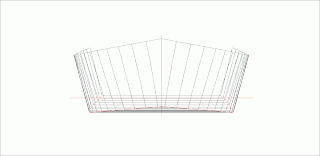
| This perspective shows Whimbrels hull viewed from the starboard bow - you can see that the base of the bow transom is close to the waterline when the boat is heavily loaded. |
 |
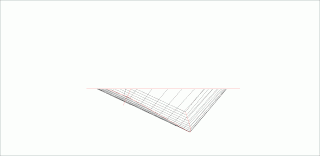
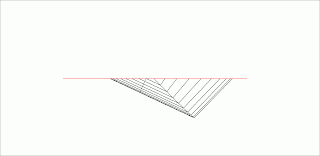
| In this drawing there are three different waterlines drawn - the deepest one with her at close to one ton of displacement, which would not be likely to occur. But even at that heavy displacement the heel of the transom is just above the static waterline. |
My argument was (and is) that the boat was designed to be only seventeen feet long, and that she would be faster, roomier, and more stable - for the load-carrying ability specified - with the large bow transom. For some background discussion on this matter have a look at this post . In fact, if I had been brave enough to withstand the negative comments, I would have made Whimbrels bow transom vertical, as I am convinced that her performance would be superior if drawn that way. I must say the raked transom looks better in profile, but Im sure the performance is degraded.
I often quote Phil Bolger in my discussions, and at the time of the Whimbrel debate I used one of his remarks about bow transoms.
 |
| Fieldmouse - scanned from a photocopy sent to a customer by Phil Bolger in October 1971. Note how the waterline is at the heel of the vertical bow and stern transoms. |
"Raked transoms make a faster boat less badly stopped by waves if they are raked out from the given bottom length, but in that case the boat would be better still if the waterline were carried out to plumb transoms at the new overall length...." (Boats with an Open Mind, International Marine 1994)
The logic in this remark seems to be lost on most people, but the technical importance of this comment, and others, has obviously been understood by commenter, Graeme: -
"No corners painted by Bolger here - even on those square boats! ;-)
Whats not to understand? Drawing the bottom (and waterline) out to be as long as the deck of an otherwise raked ends hull makes for a narrower stern and narrower bow at the waterline. The finer entry is less stopped by waves and less wet. The drawn out waterline on the same beam has higher theoretical speed. Importantly (never forget the several intricate ways Bolger stressed the virtues of "shallow", this is but one) it also has less draft, and so less resistance, thereby being more likely to achieve or exceed that theoretical speed.
It is in no way all about the bottom though. What is often passed by in what Bolger said is that its the decks that raise hull cog, and Bolger viewed decks, rightly, as a penalty. Other considerations not withstanding, he may just have stuck to raked ends, clipper bows, and such, if hed been able to design decks of weightless unobtainium. As it is, plumb ends (and sides) impose a smaller deck weight penalty on a given bottom, or on stability, or on ability to stand up to sail, or on overall performance.
Flow on efficiencies there, which may also continue to run right into the pocket.
No corners then, painted or otherwise, rather Bolgers genious yet again seen remarkably squaring a circle unlooked for. A virtuous circle spiralling on with yet more angles round each turn.
Graeme"
You can read other very interesting comments by Graeme and Rick at the end of this post.
Now, I am not saying that bow transoms are the answer to everything. Most of my designs have unusually fine, sharp sections up forard. In fact, I sometimes wonder whether I may overdo it in an attempt to cut down pounding in a short head sea.
 |
| The very sharp entry on Flint |
 |
| Periwinkle has a long, fine entry. |