Tampilkan postingan dengan label to. Tampilkan semua postingan

Answers to a couple of recent comments

| 0 komentar |
Here is comment received regarding Fleet:-

How much does she weigh?
What I like about flint is that the center of balance is over the center thwart making her easy to carry and light enough for this senior citizen to car top.


Well, I cant tell you how much she weighs because we havent weighed her yet, but the material thickness is the same as on Flint and the area of plywood is only 8.4% higher, indicating an 8.4% weight increase.  The Fleet shown in the pictures has a foredeck and inwales, but the standard Flint and Fleet have tank-tops on the foreward and aft buoyancy tanks, so it probably all evens out.

Based on just the plywood in the bare hull, the weight of Flint panels is 24kg(53lbs) and in Fleet the same is 26kg(57lbs). The centre-of-gravity of the hull panels (including transom without framing) is at 1.96metres forward of the aft perpendicular i.e. at the midships thwart near the aft edge.

The weight of any boat depends tremendously on the density of the materials used, and the attitude of the builder.
________________________________________________________________
In relation to my recent post on the virtues of the sprit rig with the jib set flying, Dennis Marshall writes: -

May I ask what the line is hanging from the peak of the sail?

Dennis is asking about the light line which can be seen in a number of photos, running down from the head of the sail at the peak end of the sprit

The light line is just visible in this photo
The line is a vang. I suggested that it be used in certain conditions when hard on the wind and when running free, to control the amount of twist in the sail, and (when running) to prevent the head of the sail from moving forward of the beam i.e. forward of a a line drawn at right angles to the centreline of the boat. If a sail moves forward of the beam, it is a sure invitation to a Death Roll.

The light line is run from the head of the sail near the peak of the sprit down to a thumb-cleat on the weather quarter and then to a little fairlead on the rudder head and then along the tiller to a small V-jamb cleat within easy reach of the helmsperson. When tacking or jibing, the line is flicked off the thumb-cleat and quickly moved to the one on the new weather quarter.  It only requires a light tension on the line (vang) to haul the head of the sail in to reduce twist in the sail.
Read More..

Answers to a few comments

| 0 komentar |
I apologise for not having replied to the last few comments, but Ive been snowed under with other duties and this is my first opportunity: -

Rossco, Did Ross Trinder use 4mm or 6mm ply on his longer Water Rat? With my 9 Water Rat I used 4mm with a full length centre stiffener of 1/4" x 4" western red cedar ( from an old verical blind) plus some smaller ply pieces and a pair of heel pegs, between the centre stiffener & the chine.You can see these in the photos I put up in Duckworks Magazine forum under "Water Rat".The bottom seems quite stiff enough with these, plus of course,the fore & aft facing seat mounting cleats. My Water Rat weighs only 17kg,which is very light,so using 6mm will probably increase it to about 25kg which is still very portable. Would "rowerwet" be better advised to use 6mm if he intends surfing his boat? Al Burke
Ross Trinder used 6mm ply on his long version of Water Rat and she turned out to be about 28kg (62lbs) which is quite heavy. However, he said that he used locally-sourced "Pink" BS1088 ply. In Australia "pink" ply normally means Pacific Maple (Meranti) or a Malaysian hardwood like Keruing all of which are quite heavy. If built from 6mm Gaboon (Ochume) the plywood weight of all of the panels in a 10.8 ft Water Rat should weigh 10.5 kg (23 lbs). Ill leave it up to your judgement to work out how much the timber, glass, and epoxy would weigh.
As Al Burke points out, the boat can be made from 4mm material, but stiffeners will be required in strategic locations. The stiffness of a panel increases (and decreases by the cube of the thickness, so 6mm ply which is supported around all edges is 3.375 times the stiffness of the same panel in 6mm!
 Here is another one from my mate, Al: -

Rossco, By way of a general comment on both First Mate & Phoenix3,I have been impressed with the speed Paul Hernes achieves in the videos of him sailing in a stiff breeze & the ease with which he handles the boat.I know the sensation of speed appears greater when close to the water,but he is ceratainly clipping along. My question is:- are both designs able to break out & plane? Al Burke
Yes, Phoenix III can break out and plane. In the following photos you can see John Shrapnel sailing Paul Hernes boat on a good day with a deep reef tied in the mainsail. This is a good demonstration that traditional rigs can drive a boat fast! I havent had direct experience with First Mate yet, but Id expect her to be as good or better due to being wider at the rail and easier to hold down. Both boats have substantial rocker, so they sit bow-high when planing, but the result is not extreme.


From Shaun come two nice comments: -

Your photos and step by step explanations are a huge selling point for me. They keep bringing me back to the blog. Not only are you highlighting your designs but are show casing the workmanship that goes into turning out a beautiful boat. I am hoping to make my first build a Flint with sails. I started a bit backward and have built some spoon oars first to get the hang of epoxy. Cheers, Shaun
Nicely done photos and commentary, makes me believe I could replicate the process. I am interested in trying some birds mouth oars. Do you include such plans with your Flint design? Cheers, Shaun

Shaun has said that he has started backwards by building oars first, in order to gain experience with epoxy. I think this is an excellent approach for an inexperienced builder and I encourage the method. The other thing to do is to build a very small tender of simple canoe so as to get the hang of the processes. In my First Mate plans I include patterns for a simple galley box which is made as a mini-stitch-and-glue project.

No, Shaun, there are no Birds Mouth spar plans for Flint, as the spars are so short and slender that the weigh saving does not justify the trouble. In fact, the spars for Flint are parallel-sided and can easily be made out of a wide variety of materials including alloy tube and carbonfibre tube. Id make them from timber - it feels nicer to the touch.


Im currently finishing off the Whimbrel plans, but due to workload the process will take about another month, I think. I like the boat very much indeed, and she should be a simple project for someone who has some experience.


Read More..

Passage to Mazatlan

| 0 komentar |
Dawn off Mazatlan


While we were in La Cruz I was able to dig further into the charger/inverter malfunction and confirmed that the charger part of the unit stopped working. This is a big deal because though we have solar panels on the boat, they are not sufficient to keep the batteries charged over the long term. The charger/inverter, a Newmar 1800, has been in the boat for about nine years so I can’t complain too much about it.

Charger/inverters are not easy to find here in Mexico and it was beginning to look like we’d be stuck in La Cruz for a few more weeks while we went through the hassle of shipping the unit back and forth to Minnesota for repairs. But as luck would have it, John Pounder at JP Marine in La Cruz happened to have a brand new Magnum 2000 in his shop that had recently become an orphan. It was ordered for a boat in Puerto Vallarta that burned up before the unit could be installed.  It took about three hours to replace the unit and another couple of hours to wire in a new remote display at the chart table. Total cost for the new unit was about $2,400. We’ll take the old one home, have it repaired and then sell it.

With that little project completed we were ready to leave La Cruz for the last time this year. Finisterra cleared the breakwater at 0810 on March 31st, bound for Bahia Matanchen, the correct pronunciation of which is Ma-tan-CHEN. We arrived late in the afternoon and dropped anchor about ¾ mile from the beach. This area has always been known for its vicious noseeums and, more recently, dengue fever carrying mosquitos. The best defense for these pests is anchoring well out in the bay, screens on hatches and ports, and DEET laced insect repellant. We spent a peaceful night at anchor and the next morning took the dinghy ashore and hitched a ride into the town of San Blas. It’s the holiday season in Mexico, with Semana Santa (Easter week) followed by Semana Pascua (Resurrection week), so the town and beaches are full of Mexican vacationers. We wandered around the town for a few hours watching the festivities, then got back aboard Finisterra around noon.
Matanchen Bay. San Blas is surrounded by one of the largest mangrove ecoregions in Mexico, encompassing 770 square miles of what we might call swamp land. No wonder the place is full of no-nos and mosquitos.

We departed Matanchen at 1330 on April 1st and headed out around the rocks that lie off Punta Camaron before heading northwest toward the beautiful city of Mazatlan. There was only about three knots of wind all afternoon and most of night as we motored over glassy northwest swells. A big waxing gibbous moon was already well above the eastern horizon when the sun set so it was a beautiful night on the sea. We arrived the following day at the anchorage off Isla de La Piedra at 0830 and anchored a couple of hundred yards east of the Escollera de Las Chivas in about 15 feet of water. People call this place Stone Island anchorage.  The last time we anchored here, the place was deserted and the palapa restaurants that line the beach were mostly closed, victims of a combination economic recession and narco-violence. Since then the cruise ships have returned and the restaurants are packed with Mexican vacationers, and a few gringos as well. 
Finisterra at anchor off Stone Island.

We spent a couple of days anchored off Stone Island and hiked to the top of Isla de Las Chivas, which is actually not really an island anymore, but is connected to the mainland by the "escollera" or breakwater that was built years ago to make Mazatlan a suitable deepwater port. There was just enough of a south swell running to make beach landings in the dinghy dampish at best so on Saturday, April 4th we got the anchor up and motored around the small islands that lie just offshore from Mazatlan to the El Cid marina where we will stay for the next couple of weeks.


Read More..

Star 45 Setting Sail on line How To Sail resources

| 0 komentar |
From: "Don Keeney" <1keyknee@281.com>
Date: Sun, 19 Nov 2006 15:39:26 -0600
Subject: [Star45] Sail Trim

A great place to learn about sail trim and sailing in general.
http://www.sailingusa.info/sail_trim.htm

Don Keeney
Star 45 Class Secretary
--
Outstanding recommendation. Wonderful site. full of photographs and all sorts of instructional materials. Pictures of tells and how to read them:)

Another must place to visit (you can try out your sailing skills):
National Geographics Interactive Sailing:

Master rudder and sail to get your boat going as fast as possible no matter what direction youre sailing in-or which way the winds blowing.

Controls available:

Sail Adjuster: Use the left sliding controller to rotate the sail in relation to shifting wind (shown as arrows). When you cross the path of the wind, your sail will swing to the opposite side.

Rudder Adjuster: Using the right sliding controller, steer to port (left) or starboard (right).


Uncle Dave
Read More..

Ensenada to Cabo San Lucas

| 0 komentar |


We had a very enjoyable three days in Ensenada, and by the 16th we were ready to continue south.  So Finisterra sailed at 1030 that morning under a beautiful clear sky and a light northwesterly breeze. Our course took us out of Bahia De Todos Santos by way of the channel between Punta Banda and Isla Todos Santos. Once out of the bay we bore off toward our next destination, Turtle Bay, which lies about 300 nautical miles down the coast of the Baja peninsula. About that time the wind fell to almost zero and we rolled up the jib and started motorsailing under the main alone. As it turned out, we had less than ten knots of breeze out of the northwest almost all the way to Turtle Bay so we ended up motorsailing the entire distance except for a few miles when the wind backed or veered enough for us to sail, which wasnt often.


We entered Turtle Bay just after sunup on January 18th and anchored a couple hundred yards from the rickety old pier in front of the village. There were no other sailboats in the bay except for a couple of derelicts anchored off in the distance. In the past weve always anchored and Enrique, the local fuel seller would bring diesel out in his specially equipped panga. But this time he told us to bring the boat up to the pier, where they have cobbled together a couple of floats to make a rudimentary fuel dock. We took on 35 gallons of diesel and gave the attendant a thirty peso tip. The poor guy nearly fell off the dock when he realized I didnt want any change back. The people in Turtle Bay dont have much, and thirty pesos, about three bucks, is a nice spiff.
A beautiful sunset every evening


While at anchor I was able to download some weather data and the forecast was for more light air for the next few days, so we didnt waste any time in Turtle Bay and by 1030 we were headed out of the bay toward Bahia Santa Maria, about 240 miles down the coast. The wind remained very light and consistent out of the northwest so we continued under power. The sea temperature rose rapidly to 68 degrees, making the nights reasonably warm. Weather in this region can be cold and stormy as easily as warm and sunny, so, remembering how we froze on the passage north through these waters three years ago, we brought plenty of heavy cold weather gear and I was grateful that we never had to use any of it. With seven knots of wind coming straight up the tailpipe on a boat moving at seven knots, the apparent wind is zero, so even though the daytime temperatures were in the sixties, we were quite comfortable.

Finisterras cockpit. On the left are the Lifesling and MOM unit. The bag on the stern rail holds fishing gear. The GPS is mounted on a swivel so it can be seen from anywhere in the cockpit. Notice that the compass cover is closed. We almost never use it anymore. All of our navigation tools are set up for true rather than magnetic directions.

The port side of the cockpit carries the outboard motor and hoist, GPS and Sirius XM radio antenna. Notice two rods mounted on the stern. Lisa rigged one with a cedar plug and the other with a pink & white. Off Mag Bay we sailed through a school of yellowfin tuna and both reels lit up almost simultaneously. We caught two little yellowfin, about 12 pounds each. We kept one and released the other. 

Watches on this passage, like the last one, consisted mainly of relaxing in the cockpit, snacking, writing up the log, reading, watching beautiful sunsets, stargazing on night watches, and then watching the sun come up.
Off watch, we would sleep, read, relax, repeat.

Finisterra was off the entrance to Bahia Santa Maria at 1900 on January 19th. We had planned to anchor in the bay for a day or two, but with the weather so fine we decided to continue south toward Cabo San Lucas instead. Later that night the wind finally arrived and we sailed through the night on a broad reach. It didnt last, though, and by morning we were motorsailing again.
A straight wake on a sea of tranquility.

We passed Cabo Falso around 2200 on January 20th and were tucked into a slip in Marina Cabo San Lucas by midnight, thus completing what was by far the most pleasant passage down the Baja coast Ive ever done.

The day before we left Ensenada the refrigerator compressor stopped working. Faced with the prospect of losing all our frozen food, we quickly packed the freezer with ice. Worse than losing our food, we were also in danger of having to drink warm beer and wine. Not acceptable. Fortunately, the day after we left the compressor started working again. Im not sure why it stopped or why it started again so Ill dig into it after we arrive in La Cruz.

I have Nobeltec navigation software on my laptop and have used it for years as my primary navigation tool. On this trip we decided to try out Inav-X on our Ipads. It is vastly superior to the Nobeltec and the charts loaded into the Garmin GPS. I never even opened the laptop.


Read More..

How to Sail the Lug Yawl REPOSTED

| 0 komentar |
My friend and fellow boatbuilder in the Northwest, James McMullen, created a very useful set of drawings to help people learn how to use our favorite sailing rig, the Lug-Yawl. For sail & oar boats you cannot have a more versatile and fun rig for your boat. Clint draws these rigs into most of his designs, such as the Calendar Islands Yawl or the Goat Island Skiff with a mizzen. Please look at these drawings and imagine how this rig could fit into your own sailing.


Now that you have seen these diagrams you can also see how useful the mizzen would be for switching from sailing to rowing and vice versa. While the mizzen is hauled in, the boat will keep herself pointing into the wind so the sail can be raised and lowered without filling and causing the boat to fall off one way or the other. I have found the mizzen useful for stopping and taking a break or for restowing gear or for dealing with safety matters. In these cases, it is best to learn to "heave-to" so that your boat doesnt lose too much ground. That is one drawback of lying head-to-wind under mizzen: you need to have plenty of leeway...no boats, rocks or land to get blown down upon. The advantage of heaving-to is that you dont lose too much ground at all. We make light, strong Birdsmouth masts and spars and have intimate knowledge of the Lug-Yawl.
Read More..

Responding to some comments

| 0 komentar |
Firstly, a note from my friend, Allan Burke,another from a contributor in Florida, and one from Woody: -

"Rossco, Just knew this design was coming! Ever since I read Munroes story something keeps stiring inside me about Egret. WHEN I win the lottery you can build US an Egret original,then well both know how she sailed. Meantime your new design on the same theme will whet many other appetites Im sure. There will be much interest in this boat of yours from those who know Egret. Al."

"Something about Egret grabs the soul! Living in coastal florida makes it even closer to home. Anxiuosly awaiting updates, as this design is closer to reality for me than the 28 replica!"

"Lovely! I wonder if the final drawling will be made for the possibility of the occasional night sleeping aboard. Woody"


Well, the customer who prompted the design of this boat has commenced purchasing materials and I hope that we may see some progress in a month or so. I dont think it will be a quick build due to his current workload, but the hull will be easy to put together once the components are assembled.

Construction is from 12mm, 9mm and 6mm marine ply using the traditional skiff construction technique of wrapping pre-cut side panels around frames and bulkheads i.e. no strongback is required. The bottom panel (12mm/1/2" ply) is fitted inside the topside panels flush with their lower edges, and then set in position with glass/epoxy as in stitch-and-glue.

As I mentioned in the original post , this design is not a copy of Egrets lines, but is an attempt to capture her character. The proportions are significantly different, as a direct copy would have resulted in some elements being unsuitable due to the difference in physical size. When drawing the new boat, I did not once refer to the Egret drawings until after I was completely finished.

As for sleeping aboard, there is just enough width to have a person sleeping on the floorboards on either side of the centreboard case. Length is not a problem.

Im very interested to see how this boat goes. She has a small sailplan, but I suspect that she will go much better than many people would expect, and the customer visualises himself poling over the flats in good weather.
_________________________________________________________?

"Love Phoenix III and First Mate. Your post prompted me to pull down L Francis "Sensible Cruising Designs", and the beach cruiser was in the book. Great inspiration. Another of his designs that would make a useful beach cruiser is "Carpenter", built lightly..."

L. Francis Herreshoffs Carpenter - 18 LOA 163"LWL 46" Beam
From Sensible Cruising Designs - International Marine Publishing, Camden, Maine
Ive always been fascinated by the shape and size of Carpenter, and in many ways she would perform the same function as Little Egret. But in my mind, I see Carpenter sailing on blue water off a rugged coast - comfortable under her modest sailplan and with her able and sea-kindly hull giving her skipper confidence....
_______________________________________________________________________

"Great post here in regards to stainless steel fasteners , my dad runs a company that produces them back in the UK, ive always been interested in their applications."

I dont use stainless steel fasteners very much because I am concerned about crevice corrosion. Stainless steel is ok as long as it is 316-grade, and is exposed to a free flow of water or air. But if the flow of air or water is restricted, rust forms quickly. A good example is the common sight of a stainless steel chain plate bolted against the topsides of a boat - the outer surface of the chain plate looks shiny and perfect, but there is a long red rust stain running down the boat where the chain plate is bolted against the hull. If you must use stainless steel, make sure it is 316-grade, and also be absolutely certain to set it in good-quality polyurethane bedding compound.

For permanent screws and nails, I use silicon bronze, but I do make extensive use of 316-grade stainless steel screws and brads for temporary fastening. People ask me why I use stainless if the fastenings are going to come out anyway? The answer is that if one breaks off, at least there is some chance that it will resist corrosion if it is burried in epoxy.
_______________________________________________________________

"Curious as to what design is "waiting in the wings" that may use leeboards. Sounds interesting. Maybe its the one that will balance with a passenger seated on the aft thwart? Woody"


Well, there is the hull I was talking about. She is the same sort of size as Phoenix III and First Mate, but built either as a strip planked hull, or as a glued-lapstrake (clinker) hull with eight planks per side. The transom is shown vertical, but in the finished drawings it will have 10 degrees of rake. Breadth at the rail has been carried forward so as to allow adequate spread at the oarlocks when rowing from a forward position (yes, Woody, you were correct) and to provide reserve buoyancy. The other reason for carrying the breadth forward is to allow for better mounting of leeboards if that was considered.

These plans wont be available for quite some time, as I am too busy with building work, but I would like to build one for my own use - maybe....
___________________________________________________________________________?


Read More..

Back to business boat kits and complete boats

| 0 komentar |

First off, I am now in 100% complete control of my Gmail account again. Someone in Egypt hacked in because I was not careful enough about protecting my password. Upgrade passwords and never have it on email anywhere! Learn from my mistakes. My email, boatkits@gmail.com, is completely safe, now.

Pictured is a recent boat kit heading out of the shop...CNC (computer numerically control) precut plywood kit and a timber kit. The pieces of mailing tubes over the ends of the long parts protect the precut scarf joints while the kit is shipped (this one a kit to Durango, CO).

Back to business and to pick up from the last few posts, I want to share a PDF and link to my webpage about how my kits are produced, why it makes more sense to built boats out of my catalog from kits or full size patterns, and the general idea regarding the economics of boat kits (i.e., why the extra cost of a boat kit is smaller than many think) will come next time.

http://www.clintchaseboatbuilder.com/CNC.html

My pitch for building from boat kits PDF (Google Docs)

In a nutshell, boats designed in the computer are actually drawn full size already to a higher degree of precision (thousandths of an inch) than on the lofting full size by hand (1/16ths of an inch). The difference is that a planks can be precut in advance, glued together with a precut scarf, and bent around bulkheads, hitting every mark on the spot. Interior components and the building jig itself are drawn into the computer model to exactly fit the boat. Therefore, to take a computer aided drafted (CAD) boat and loft it by hand introduces natural errors that were carefully avoided in the CAD process.

Because the parts can all be predetermined off the computer model, they can be nested onto fewer sheets of plywood than a manually (scratch-built) boat can be done. Also, it avoids cutting mistakes which often requires buying extra wood. This offsets the extra cost of a kit and wastes less wood.

The time it takes to manually cut parts to a boat, if you look at it in a hourly rate kind of way, would also offset any remaining difference in cost between building from scratch versus building from precut parts in a kit.


Read More..

Punta de Mita to Isla Isabel

| 0 komentar |
We were up well before dawn on Saturday, March 26th, the day the Honcho made its final departure from Punta de Mita. We got underway just in time to see one last spectacular sunrise over the bay, before we headed north to another storied bay, Bahia Mantanchen. Sailing conditions were excellent and we made good time, getting the anchor down in Mantanchen Bay in mid afternoon. This bay is famous for its great surf and its Jejenes, otherwise known as noseeums, nonos,  or sand fleas. All of those appellations are often preceded by a rather forceful adjective because of their ability to inflict an itching, bleeding, scratching kind of misery on everyone they come in contact with. We were well prepared, with fine mesh bug screens on the hatches, DEET laced sunscreen and bug repellent, and a take-no-prisoners attitude. We passed a peaceful and bug free night and got the anchor up early to head for our next destination, Isla Isabel.

Punta de Mita Sunrise
Isla Isabel has been described as the Galapagos of Mexico because of its remoteness and isolation. Consequently it is the nesting and breeding ground for vast numbers of sea birds, particularly blue-footed boobies and the magnificent frigate birds. The island is a Mexican National Park and a World Heritage Site, so its unique flora and fauna are well protected. It was truly a spectacular place to visit.

We anchored on the east side of the island, just south of Isleo Mona Menor, about a hundred yards off the beach. Eager to explore the place, we pumped up the inflatable kayak and paddled ashore. There we were confronted by a couple of Mexican naturalists who informed us that it was illegal to land there and advised us to go around to the south side of the island and land at the fish camp that was located there. It was too far for our flimsy kayak so we went back to the boat and launched the dinghy and motored around to the spot we were supposed to land. Our entire experience there was fascinating, but instead of trying to put it all in words, Ill let the photos do most of the talking.
The Honcho at Anchor, Isleo Mona Menor in the background

Fish camp on the south side of the island, our dinghy is at left. Notice the hundreds of birds above the hill.


Booby chick on the beach. There were thousands of these babies on the beaches of Isla Isabel. Below, an adult blue footed booby


These birds will grow up to be incredible flyers and fishermen. The boobies appeared to nest mostly on the beaches and rocks, while the frigates built their nests in the trees or grassy areas inland.


Frigate nest in a tree. Notice the chick. These birds showed no fear of humans, we were literally within an arms length of this mother and chick. Below, a frigate chick stares back at the camera


Isla Isabel is an extinct volcano and therefore has a crater lake in the middle of it.  With very little impact from man, it looks wild and primitive, and beautiful in an eerie way,


The following day we got the anchor up and, punching into a 15 knot headwind, the Honcho began the long beat to Mazatlan, 85 miles distant.
Read More..

Homeward Bound Los Cabos to Bahia Santa Maria

| 0 komentar |
We stayed about a week in San Jose del Cabo at the luxurious and expensive Marina Puerto Los Cabos. Actually it’s not really luxurious. It doesn’t have a pool or much in the way of amenities for cruising sailors. Instead it caters to sportfishermen and mega yachters, a totally different type of clientele. It is very well maintained and has a nice little open air restaurant where you can get a hamburger for only about $13.00. That’s dollars, not pesos. The marina is beautifully landscaped and the docks are perfectly maintained, while the staff is mostly quite friendly and helpful. On the other hand, it has a sterile, soulless ambience along with plenty of security. I credit this to the mostly absentee ownership of the boats that call this place home. Of the hundred or so boats in the marina there were only five or six sailboats, most of which had people living aboard who were, like us, simply waiting for a weather window to head north to the US.

While we waited for the window to open, we spent a little time preparing the boat for the arduous 900 mile trip up the outside coast of Baja, but there really wasn’t much to do, as Finisterra was pretty much ready when we left La Paz. I had the bottom cleaned, changed the fuel filters and gave the engine a thorough inspection because we expect to be motoring or motorsailing for the nest 900 miles. There are very few places on the outside of Baja that have fuel or any kind of marine services so we want the engine systems in tip top shape. We also want the sails and rig to be in top form. There was nothing to do in that respect except give it all a thorough once-over. The only thing on the to-do list was to make a set of sail ties for the reef points. With all that done, we spent the rest of our free time checking out the beaches and hanging out in the very upscale environs of San Jose. It really wasn’t a very fun place to be and I confess that I checked the weather forecasts several times a day, looking for the first opportunity to get out of San Jose.

One of the new “attractions” at the marina is a Dolphin Discovery exhibit. It consists of three or four large pens next to the marina where they keep a half dozen or so dolphins in captivity. Tourists pay for the experience of getting into the pens with the dolphins for a personal encounter. We walked past the place several times in the early mornings, before the customers arrived and watched the captive dolphins swimming around in the pens while the “trainers” got ready for the day’s show. The poor dolphins looked pathetic compared to the exuberant ones we always see in the wild, and the whole concept of keeping these animals in captivity for profit disgusts me. I hope you never pay to pet a dolphin.

My primary sources for weather information are Predictwind and GRIB files. GRIB’s provide a good overview of winds in the region while the information from Predictwind is more detailed and specific. By Monday, June 2nd, the forecast started looking good for a Saturday departure, but as the week wore on, the forecast for the area around Cabo began to worsen. So we could either leave on Friday morning or wait for the forecasted adverse winds to pass by, which could be another week or more. We decided to take advantage of the current conditions and quickly checked out of the marina and got underway at 0930 on Friday, June 6th, bound for Bahia Santa Maria.

The wind was light when we left San Jose but quickly built to 20-25 knots on the nose as we approached the Cape. In the twenty miles between San Jose and Cabo San Lucas the sea temperature plummeted from 83 to a surprising 68 degrees and we prepared for a chilly passage. But after rounding Cabo Falso, the last point of land before we could turn northward, the wind began to ease and the sea temperature rose to a much more comfortable 77 degrees. For the rest of the day and throughout most of the night we motored in balmy seas and a light wind. It was still on the nose though.
Finisterras route from San Jose del Cabo to Bahia Santa Maria

That night there was a waxing gibbous moon amid scattered clouds until around 0200. After the moon set the overcast sky cleared and we were kept company by the vast Milky Way, with Polaris, the north star off our starboard bow. The next day we continued in lovely light conditions until around noon when the wind and seas built. By 1500, when we arrived at Bahia Santa Maria it was again blowing 20 with a bumpy sea throwing spray over the dodger.


We are anchored in the northwest corner of the bay now. The wind is still blowing hard outside the bay, but I expect it to lie down a bit this evening. If it does, we’ll get underway around midnight, and head toward Turtle Bay, 220 miles away.
Read More..

a project you might want to check out during 2016

| 0 komentar |
Some exciting stuff, regarding those dire predictions, and something well worth the read...

Someones been busy.


I expect youll be able to find out more as it develop over at Boat & Koad.

Listening to a plethora of good covers

So it goes...
Read More..

Fitting Different Rigs to an Existing Boat

| 0 komentar |
One of the great joys of owning and/or building a small wooden sailing boat is that there is plenty of opportunity for experimentation. For some reason it doesnt seem right to go shifting things around on a glass production hull, but wooden boats lend themselves to modification. With high-quality epoxy and fastenings, the end result should be as good, or better, than the original work.

Ive mentioned previously that rig modification was something which interested me from before I left school. I had been brought up sailing racing boats at the local club, all of which had modern, deck-stepped rigs with lots of stainless-steel fittings and sails full of batten pockets. Although I loved the sailing, I felt the urge to cruise alone in a boat fitted with a more simple, traditional rig such as a standing lugsail.

Phoenix at about age 20 with her original rig
For me, the first real experiment came when I converted the cruising dinghy my Dad had designed and built. She had been constructed with a deck-stepped Bermudan rig just like all of the racing boats Id sailed. She was (and still is) a fine boat, but I got it into my head that Id re-rig her with a Chinese Lugsail (a.k.a. Chinese Junk Rig). I spent a long time on the calculations - far too long, I believe - but that was because I didnt really know how accurate I had to be with all of the proportions, and I was particularly concerned about the location of the centre-of-area of the sail in relation to the centre-of-lateral resistance of the boat.
Phoenix showing how well she could get to windward with her Junk Rig. A nice day in tropical North Queensland.


Accelerating out of the tack and heading off hard on the wind. This rig was exceptionally easy to handle, reef, and furl, and has been one of my all-time favourite rigs. I will be making another one sometime...

After the Chinese Lug rig, I fitted the same hull with about four or five other sail configurations, finally settling on the Balance Lug which she currently carries.

When I designed boats such as Phoenix III, First Mate, and Periwinkle (and some others which have not yet been published), I decided from the outset that I would arrange the rig proportions so that several different rigs could be used on the same mast(s) and/or using the same mast step and partners. This results in boats which can be rigged in a number of different ways without having to make any physical alterations to the structure of the boat. I have already spoken about this a little in my post about Phoenix III and the Perfect Customer 

Here are some more photos to illustrate what I mean.
John Shrapnels Periwinkle showing her standard Cat Ketch (Periauger) rig. Crew weight is a little far aft, but she is going nicely. This boat is very fine up forard, and needs to have weight kept out of the bow when pressed.
Same boat, but with the mizzen removed and the mainmast and mainsail moved aft to another mast step and partner. The rig is still perfectly well balanced, even though the 51sq ft mizzen has been removed entirely.
Here she is with just the mainsail up, stepped in the middle location, but with a substantial reef tied in. It may look calm in the little bay, but it was blowing outside on the more open water.
When it really starts to blow, or when the crew weight is low, you can set the mizzen in the central location. Once again the hull balance is fine, but the rig has been reduced to a snug 51 sq.ft. Even so, when this picture was taken, the boat was doing 8 knots by GPS! If you needed to , even this sail can be reefed.
This shows you the rig combinations on paper. Note how well the centres-of-area cluster near the centre-of-lateral resistance of the hull in all combinations. The key to this was careful proportioning of the sails and the mast locations.
This is another rig which can be used on the boat. The little flying jib is optional, but will help her a lot and will stand ok without shrouds or backstays. The gaff-headed cat rig is set on exactly the same mainmast as in the standard rig, so there is no alteration required to any part of the boat. This print is of an early sketch and some elements are not shown.
...and her you can see Graham Faulkners Periwinkle with the Gaff-Cat rig, beachcruising on Fraser Island, Queensland, Australia (this was the second boat built, and Graham even made his own sail!)
This shows the three mast locations - the mainmast partners in the lower/left of the photo, the central position through the main thwart, and the mizzen partner through the stern sheets (aft thwart)
All of that thinking made me very tired! Actually, that is just me showing the comfortable sleeping position on either side of the centreboard case.
Build yourself a wooden boat, and then try some rig experiments - it is great fun.
Read More..

La Paz to Bahia de Concepcion

| 0 komentar |
Ensenada Grande with mainland Baja in the background.
On Saturday, April 13th we went grocery shopping at the local Mega, took a long swim in the pool and had dinner at Steinbecks. The next morning we checked out of Costa Baja and headed north to Isla Partida. In the Sea of Cortez the wind generally blows up the sea or down the sea. Today it was blowing down the sea so we motor-sailed directly into a 15 knot headwind and lumpy, choppy seas as we passed up the west side of Isla Espiritu Santo toward our destination of Ensenada Grande on the west side of Isla Partida, arriving in the late afternoon. There were a few other boats in the anchorage, but it’s a big enough bay that we were able to anchor in a fairly secluded spot close to some bluffs on the south side of the bay. The water was clear enough that I could see the anchor send up a cloud of sand as it hit the bottom 22 feet below the surface. This made the snorkeling great, and we saw lots of tropical fish and healthy looking coral. Later we took the dinghy around the southern end of the bay, past Punta Tijeretas and into the tiny cove of Las Cuevitas where there is a blue footed booby rookery. It’s not the nesting season now, but there were still a lot of boobies around. That night I set my alarm to wake up at 0200 so we could watch a total eclipse of the moon. There is something awesome about seeing a lunar eclipse from the deck of a sailboat where there is no light pollution from any nearby civilization.
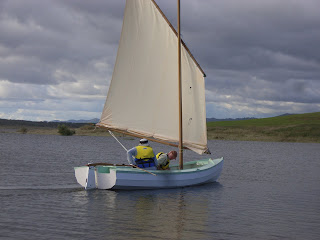
Sunset is a perfect time for a paddle in Ensenada Grande.
I have no idea how these unusual rocks were formed but they are fascinating to explore.


While there, we hiked up the hills behind the bay and explored the strange rock formations that line the north side of the bay. When we got restless we sailed north again toward the fishing village of San Evaristo on the mainland of Baja.

With a nice breeze out of the southeast, we had a pleasant sail for about twenty miles then about six miles from the anchorage, the wind died and we began to motor. We had been trolling all day without a bite, but about four miles out, the reel lit up and we caught a 20 pound dorado.  This was our first fish of this kind and as soon as we got the anchor down in Evaristo I had the BBQ out and we had a fine meal of grilled dorado, wild rice and a fine bottle of pinot grigio, supplied by my friends at C1. Thanks guys!  We spent a couple of days in Evaristo then departed for Puerto Los Gatos, about thirty miles up the Baja coast.

We caught him just in time for dinner.

A dorados beautiful colors quickly fade when they die. After giving him a couple of shots of rum this fellow relaxed and died peacefully.

It was a beautiful starboard tack reach, with about 12 knots of wind out of the east under a hazy, somewhat overcast sky. I like the overcast because it provides some relief from the sun, which can be brutal here in the Sea. We approached Los Gatos from the southeast and saw a boat anchored in the far northern part of the bay, which is about half a mile wide. We anchored in the southern part of the bay, about as far from the other boat as we could get and were looking forward to a beautiful, quiet evening.  But within an hour three other boats came into the bay and anchored close enough that we could hear them talking as they enjoyed their sundowners.  A couple of them left early the next morning so we were able to explore this beautiful bay pretty much in peace and solitude. Different voyages have different flavors. The last time we were here, three years ago, we were delighted to have lots of friends from other boats around. This time, we have been inclined to seek the solitude of empty bays and quiet nights. 

Our dinghy is a speck on the beach at Los Gatos.
On Saturday, April 19th we got the anchor up early and headed for Bahia Agua Verde, about 13 miles north. With three knots of wind out of the southeast, there was no point in trying to sail, so we fired up the diesel and a couple hours later we anchored about a hundred yards off the beach in Agua Verde. Since it was the day before Easter Sunday, the beaches in the fairly large bay were crowded with Mexican vacationers here to celebrate the holiday. The next morning we hiked into the country behind the little settlement. Aside from fishing, the locals raise goats, pigs and a few cattle. There is a school and church, along with a couple of small tiendas and a restaurant or two, so Agua Verde, though it has no cell phone or internet service is fairly cosmopolitan compared to most other places in this part of Baja California.

Later in the day we raised the anchor and continued north 22 miles to Puerto Escondido.  We arrived around 1700 and passed through the narrow channel into the lagoon that makes this place an excellent all weather port of refuge. The lagoon is over a mile long and half a mile wide and until recently had over a hundred moorings. Now there are only a few moorings left, and they don’t look well maintained. Ashore, things have declined from the last time we were here. There is still a boatyard with a Travelift and a floating dock and a few boats hauled out here, but the place is pretty desolate. The restaurant has closed down and so has the little tienda. Puerto Escondido should be a thriving community, but apparently there has been a lot of disagreement within the local business community and with the government which has had a bad effect on the village. We had hoped to stock up on fresh food and use the Internet here, but instead we spent one night in the lagoon tied to an iffy looking mooring and left the next morning for the town of Loreto, about 14 miles up the coast.
Puerto Escondido sunrise. Regardless of the business situation in the village, the scenery remains awe inspiring. 
There is a tiny harbor at Loreto but it is for the exclusive use of the local fishermen, so we anchored outside and took the dinghy into town where we had a nice meal at the Hotel La Mision, checked email and wandered around the town a bit before heading back out to the boat. While ashore we visited a unique museum of sorts, with the skeletons of whales and dolphins on display.  Back aboard Finisterra, we spent a peaceful night anchored outside the harbor, then left early the next morning for Caleta San Juanico.   

 The distance from Loreto to San Juanico is about 27 miles and with scant wind, we motorsailed the entire distance, arriving in the early afternoon. There were four or five boats anchored in the north end of the bay and a couple more at the south end, so we chose a nice spot just off the beach in the middle part of the bay, anchoring in about 15 feet of water. With a light breeze coming out of the southeast and crystal clear water, the swimming was delightful. Later we grilled the last of the dorado I caught a week ago for dinner. The next morning we were underway early for the 50 mile passage to Bahia de Concepcion.

Caleta San Juanico is dotted with rocky islets.
 The wind blew out of the northwest, exactly the direction we wanted to go, so we motored toward Punta Concepcion until we were a few miles out. Then the wind shifted to northeast and piped up to about 20 knots and we had a fast sail around the point and about six miles down the bay. Then we furled the sails and picked our way through the pass between Punta Piedrita and tiny Isla Pitihaya, toward Playa Santispac. There were several boats already at anchor there, so we bore away toward the little cove at Posada de Conception where we anchored in about 20 feet of water in the lee of some tall bluffs which offered good protection from the strong northerlies that sometimes blow down the Sea of Cortez. Finisterra was to remain at anchor here for the next nine days. 


Read More..